2012年1月28日

The 4th "Let's Speak Japanese" - Participants Wanted

The 4th "Let's Speak Japanese" - Participants Wanted
Let's enjoy games and a quiz in Japanese!

 This event will be held for foreigners who live in Japan and can speak some Japanese, and Japanese support people.

Date and time: February 12 (Sun.) 10:00a.m. to 3:00 p.m.
Place: Tsukuba Science Information Center (Next to Nova Hall)
Azuma 1-10-1, Tsukuba

If you come by car, please park in a toll parking lot.

☆A stamp collecting game will be held. If you try some programs, you will get a point. Please try to collect points and get a prize.

Contents:
Participants can join in Part 1 and 2.
☆Part 1               From 10:00 a.m. to 12:00 p.m.
Enjoy the event: a quiz and experience of Japanese culture
Traditional Japanese experience (Origami, making a toy gun with rubber bands and waribashi)
                            From 12:00 p.m. to 12:30p.m.
Cross-culture party, bread party some bakery bread will be sold for 300yen (3 breads and drink)
*There will be vegetarian bread available.

☆Part 2 From 12:30 p.m. to 3:00 p.m.
Japanese traditional program
Calligraphy, juggling, time trial to write Hiragana and Katakana in 3 minutes, Kanji reading from cards (You will try to read the Kanji which you see on the card.)
Who: People who study Japanese (from beginner to advanced), people who want to communicate with foreigners.

☆Part 3 From 12:30 p.m. to 3:00 p.m.
Observation only.
Discussion for foreigners

・Youth Age Meeting (Junior high school and high school students)
Theme: Going to Japanese High school

・Discussion of Adults (Round table meeting)
Theme: Experience of March 11

Who: Foreigners and people interested in intercultural exchange

How to register: Please call the number below (You can apply on that day)

【For more information and registration contact】
Tsukuba International Association
TEL: 029-869-7675
E-mail: inter@tsukubacity.or.jp

2012年1月18日

Nihongo Cafe Japanese Language Clinic

"Japanese Language Clinic"

Expert Japanese teachers and volunteers will answer your questions.

Date: Janurary 28 (Sat.)
Time: 10:00 a.m. to 12:00 p.m.
Place: Tsukuba Science Information Center
          1-10-1, Azuma, Tsukuba

How to register: Please come directly. If you have any special questions about the clinic, please ask us in advance.

For more information:

Tsukuba International Association
TEL 029-869-7675
E-mail inter@tsukubacity.or.jp

2011年12月7日

Shopping - sugar and salt

When I first arrived in Japan I didn't know many kanji, and sometimes I forgot to take my dictionary to the supermarket. One of the most confusing things was salt and sugar - which is which???

This picture shows the kanji for 4 types of sugar:

糖 とう sugar    

This just means "sugar" but most bags have a different name, for example -->

グラニュー糖  
ぐらにゅー とう 
"guranyu tou"      granulated sugar


白砂糖   しろざとう  "shirozatou"        white sugar

黒砂糖   くろざとう "kurozatou"        brown sugar


But please be careful! If you want simple sugar for cooking, to put in your tea, etc, then please choose granulated sugar. It is like sand and is not sticky. This is the sugar you will find in western countries.

Japanese "shirozatou" means "white sugar" and it is cheaper than granulated sugar BUT it is very fine grained and it is sticky. The taste is the same as granulated sugar but if you try to use it in a recipe, your baking will turn out differently.

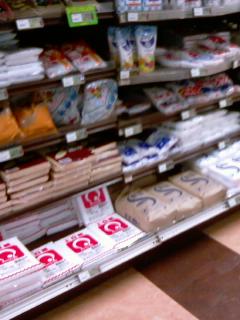
Salt is always sold next to sugar. Nowadays there are many kinds of salt and some bags have English on them, so it is easier to understand which is sugar and which is salt. Long ago I made a mistake and bought 2kg of salt when I really wanted sugar!

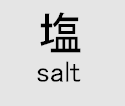
塩  しお  
"shio"      salt


2011年12月3日

Nihongo Cafe Origami

Today was a really rainy day, but some  people joined our Japanese cafe.

We made a tulip, cup and crane and so on. We spoke basically Japanese and some of mix English or Chinese.

It was so nice an opportunity to communicate with people from many countries.

2011年11月27日

School entrance examinations and cram schools

Japanese children go to elementary school for 6 years and then go to junior high school for 3 years. These 9 years are compulsory education.

In Ibaraki prefecture, 98% of all junior high school graduates enter high schools.

To enter the best high school for them, children must pass the entrance examination for the school they choose. In Ibaraki prefecture, there aren’t enough public high schools to accept all the students, so there are also private high schools.

Since private high school tuition is very expensive, most parents would want their children to go to a public high school. And all public high school’s examination date is the same day so that children can try just one public high school examination. However, recently the number of parents who send their children to private schools is increasing because private schools are believed to have better education systems and facilities.

In order to pass the entrance examination to the best school, many students attend special preparation cram schools (juku). Even though the tuition fee of a juku is of course very expensive, most parents send their children to a cram school to make them win the most competitive examination race.

Well, this entrance exam system is a characteristic of Japan. So junior high school students, especially 3rd graders must be studying really hard and most of them go to a cram school. Cram schools are not only very expensive but parents also have to drive their children to and from cram schools during busy evenings, or even if children can go to the cram school by themselves it would be worrisome for the parents.


By the way, how do the students choose which high school’s examination to try?

One of my sons is a 3rd grader in a junior high school and is now studying hard to pass the examination to the high school he wants to attend. He was a handball player in his junior high school, so he chose a private high school and a public high school which both have decent handball team for him.

Like my son, so many students choose their high schools because of a club activity such as soccer, basketball, volleyball, brass band and so on. There are students who choose their high school from high level schools, in order to prepare for the next competitive race “University entrance examinations”.

High school entrance examinations will all finish in March. I wish them good luck!

2011年11月8日

Nihongo Cafe

Nihongo Cafe
Let's try speaking Japanese while making Origami.


December 3 (Sat) 10:00AM to 12:00PM

Place: Tsukuba Gakuin University #2208
3-1, Azuma, Tsukuba

Content: “ORIGAMI”

2011年10月16日

Friendship party by Cosmo Echo

'Cosmo Echo' is going to hold a 'Friendship party' at the Tsuchiura-sanchu Community Center (三中地区公民館) near Joyful-Honda, across from the Xebio Dome on Higashi-Odori on October 23.


(map is below on this page)

Cosmo Echo is a volunteer group which was established after the Tsukuba Science Expo in 1985 by volunteer translators who were working there.Since then Cosmo Echo has organised a lot of events, such as 'Kimono-try-on party','Tea ceremony','Tanabata Party, etc...... Through these events Cosmo Echo is helping foreigners understand the Japanese culture.

Cosmo Echo's volunteer members are very friendly and they speak English. They also try to use simple Japanese together with body language for people who don't speak either English or Japanese well.


大きな地図で見る

This is the timetable of the Event.
10:30-12:00 A performance of shakuhachi, shamisen and dance
12:00-13:00 Lunch time (Lunch and desert will be served.)
13:00 - 15:00 Culture Exchange time
(A little talk by all guests and free conversation.)
It is free to join.
The capacity of the event hall is not so big and the lunch has to start being prepared a few days before.
Cosmo Echo needs to know how many people would come in advance. So if you decide to come to the event, please let us know by leaving a message in the comment box by October 19.